Marketing automation Singapore has become a crucial strategy for businesses looking to scale their marketing efforts efficiently while maintaining personalised customer engagement. As digital competition continues to grow across industries in Singapore, companies must find ways to communicate with prospects and customers consistently across multiple channels. Marketing automation helps organisations achieve this by streamlining repetitive marketing tasks and enabling data-driven decision-making.
Businesses today must manage email campaigns, lead nurturing, social media engagement, website tracking, and analytics simultaneously. Handling all these activities manually can quickly overwhelm marketing teams. Automation technology allows companies to manage these tasks more efficiently while ensuring every potential customer receives relevant and timely communication.
From startups to large enterprises, organisations in Singapore are increasingly adopting marketing automation platforms to improve operational efficiency and marketing return on investment (ROI). By combining automation tools with customer data and behavioural insights, businesses can deliver highly personalised marketing experiences at scale.
This comprehensive guide explores how marketing automation works, the strategies businesses in Singapore can implement, the tools available, and how companies can measure the success of their automation initiatives.
Table of Contents
- Why Marketing Automation Matters for Singapore Businesses
- Key Marketing Automation Strategies
- Implementation Framework for Marketing Automation
- Data, Analytics, and ROI Measurement
- Recommended Marketing Automation Tools
- Case Study: Automation Success in Singapore
- Future Trends in Marketing Automation
- FAQs
- Conclusion and Next Steps
Why Marketing Automation Matters for Singapore Businesses
Singapore is one of Southeast Asia’s most digitally connected economies. Consumers interact with brands through websites, social media platforms, messaging apps, and email. This multi-channel environment creates new opportunities for businesses but also introduces new challenges in managing customer relationships.
Marketing automation allows organisations to coordinate marketing efforts across different channels while maintaining consistency in messaging. Instead of relying on manual processes, automation platforms enable businesses to create structured workflows that respond automatically to customer behaviour.
Some of the key benefits of marketing automation include:
- Improved marketing efficiency
- Faster lead response times
- Better customer segmentation
- More personalised marketing communication
- Higher conversion rates
- Better visibility into campaign performance
Without automation, marketing teams often spend a large portion of their time performing repetitive tasks such as sending follow-up emails, organising lead lists, and scheduling campaigns. Automation platforms reduce these manual workloads and allow teams to focus on strategy, creative development, and data analysis.
How Automation Improves the Customer Journey
One of the biggest advantages of marketing automation is the ability to create a seamless customer journey. Automation workflows allow businesses to deliver targeted messages based on customer behaviour.
For example, when a visitor downloads a guide from a website, the system can automatically trigger a series of actions:
- Send a follow-up email with related resources
- Add the lead to an educational email sequence
- Notify the sales team of a potential opportunity
- Track engagement to determine lead interest
These automated interactions ensure that potential customers receive relevant information at the right time while allowing marketing teams to manage thousands of leads simultaneously.
Key Takeaway Box:
Marketing automation enables Singapore businesses to scale personalised marketing experiences while improving operational efficiency and lead management.
Key Marketing Automation Strategies for Singapore Companies
Successful marketing automation requires more than simply installing software. Businesses must design strategies that align with their customer journey and marketing objectives.
Below are several automation strategies commonly used by companies in Singapore.
Lead Nurturing Campaigns
Lead nurturing is one of the most important applications of marketing automation. Not every visitor is ready to purchase immediately, so businesses must guide prospects through a process of education and engagement.
Lead nurturing campaigns typically include:
- Welcome email sequences for new subscribers
- Educational content delivered over time
- Invitations to webinars or events
- Product comparison guides
- Consultation or demo offers
These automated sequences keep potential customers engaged while gradually building trust in the brand.
Behaviour-Based Personalisation
Modern marketing automation platforms can track user behaviour across websites, emails, and campaigns. This information allows businesses to tailor communication based on customer actions.
Examples of behavioural targeting include:
- Sending product information after a visitor views pricing pages
- Recommending blog articles related to previously viewed topics
- Triggering reminder emails when users abandon a registration form
Behaviour-based marketing improves engagement by ensuring customers receive information relevant to their interests.
Customer Lifecycle Automation
Marketing automation can also support the entire customer lifecycle. Instead of focusing only on lead generation, businesses can use automation to maintain long-term customer relationships.
Examples include:
- Customer onboarding sequences
- Product training emails
- Renewal reminders
- Upsell and cross-sell campaigns
- Customer feedback surveys
These workflows help businesses maintain ongoing engagement with customers while increasing customer lifetime value.
Multi-Channel Campaign Automation
Marketing automation platforms now support communication across multiple channels. Businesses can coordinate campaigns across email, social media, SMS, and paid advertising platforms.
Examples of multi-channel automation include:
- Automated email campaigns
- Social media post scheduling
- Retargeting ads based on website activity
- SMS notifications for event reminders
This approach ensures that customers receive consistent messaging regardless of the platform they use.
Key Takeaway Box:
Combining lead nurturing, behavioural targeting, and multi-channel communication creates a powerful marketing automation strategy that improves engagement and conversion rates.
Implementation Framework for Marketing Automation
While marketing automation offers many benefits, successful implementation requires planning and structured processes.
Common Marketing Challenges
Businesses often struggle with several marketing challenges, including:
- Low lead conversion rates
- Slow follow-up with potential customers
- Inconsistent communication across channels
- Difficulty tracking marketing performance
- High manual workload for marketing teams
Marketing automation platforms address these issues by automating repetitive tasks while providing real-time insights into campaign performance.
Step-by-Step Implementation
Before implementing automation, businesses must understand how customers interact with their brand.
Step 1: Map the Customer Journey
Key stages in the customer journey include:
- Awareness: Customers discover the business through content or advertising
- Consideration: Customers research solutions and compare options
- Decision: Customers evaluate whether to purchase
Mapping this journey helps marketing teams design automation workflows that support each stage.
Step 2: Choose the Right Automation Platform
Selecting the appropriate platform is essential. Businesses should consider several factors when evaluating marketing automation tools.
Important considerations include:
- Integration with CRM systems
- Workflow automation capabilities
- Email marketing features
- Reporting and analytics dashboards
- Scalability for future growth
Choosing the right platform ensures long-term sustainability for automation initiatives.
Step 3: Build Automation Workflows
Once a platform is selected, businesses can begin designing automation workflows that support their marketing objectives.
Examples include:
- Lead nurturing email sequences
- Event registration follow-up campaigns
- Customer onboarding workflows
- Re-engagement campaigns for inactive leads
Pro Tip
Start with a few essential workflows before expanding automation across the entire marketing strategy. This approach reduces complexity and allows teams to refine processes gradually.
Data, Analytics, and ROI Measurement
One of the most powerful aspects of marketing automation is the ability to measure marketing performance using detailed data.
Automation platforms collect data from multiple sources, including email campaigns, website activity, social media engagement, and CRM systems.
Key performance metrics include:
- Email open rates
- Click-through rates
- Lead conversion rates
- Customer acquisition cost
- Marketing return on investment
By analysing this data, businesses can understand which campaigns generate the best results.
Understanding Marketing ROI
Marketing automation also helps companies calculate ROI more accurately.
For example, automation systems can track:
- The number of leads generated from a specific campaign
- The percentage of leads that convert into customers
- The revenue generated from those customers
This information allows marketing teams to evaluate which campaigns deliver the greatest value and optimise their strategies accordingly.
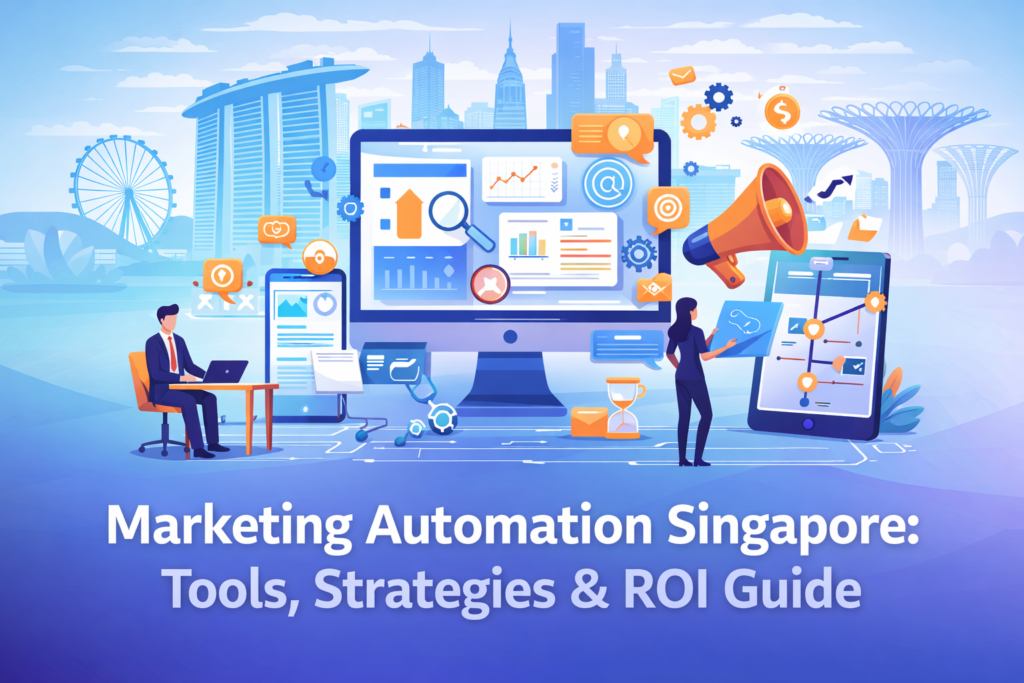
Example marketing automation workflow connecting lead capture, nurturing, and sales engagement.
Recommended Marketing Automation Tools
Selecting the right platform is essential for implementing marketing automation successfully. Several tools are commonly used by businesses in Singapore.
HubSpot
HubSpot is one of the most widely adopted marketing automation platforms. It offers a comprehensive set of tools that integrate marketing automation with CRM capabilities.
Key features include:
- Email marketing automation
- Lead scoring and segmentation
- Landing page creation
- Campaign analytics
HubSpot is suitable for growing businesses that want an integrated marketing and sales platform.
ActiveCampaign
ActiveCampaign is known for its powerful automation features and affordable pricing structure.
Core capabilities include:
- Behaviour-based automation workflows
- Customer segmentation
- Email campaign management
- CRM integration
This platform is popular among small and medium-sized businesses.
Mailchimp
Mailchimp began as an email marketing platform but has evolved into a broader marketing automation solution.
Its features include:
- Email automation workflows
- Audience segmentation tools
- Campaign analytics
- Integration with e-commerce platforms
Mailchimp remains a popular choice for startups and small businesses.
Salesforce Marketing Cloud
Large enterprises often use Salesforce Marketing Cloud because of its advanced features and scalability.
Key capabilities include:
- Multi-channel marketing automation
- AI-driven customer insights
- Advanced campaign analytics
- Integration with the Salesforce ecosystem
Key Takeaway Box:
The best marketing automation platform depends on business size, marketing complexity, and integration requirements.
Case Study: Marketing Automation Success in Singapore
Client: B2B Technology Company (Singapore)
The Challenge
The company generated significant website traffic but struggled to convert visitors into qualified leads. Marketing teams spent large amounts of time manually following up with prospects
The Strategy
A marketing automation platform was implemented to streamline the lead management process. The system included automated lead capture forms, email nurturing campaigns, and behaviour-based lead scoring.
Automation workflows were integrated with the company’s CRM platform so that sales teams received notifications when leads reached specific engagement levels.
The Results After 90 Days
- 35% increase in qualified leads
- 22% increase in email engagement rates
- 18% increase in sales conversions
- 40% reduction in manual marketing tasks
This example demonstrates how automation can significantly improve marketing efficiency and lead generation performance.
Future Trends in Marketing Automation
Marketing automation continues to evolve as new technologies emerge. Several trends are shaping the future of automation in Singapore’s marketing landscape.
Artificial Intelligence Integration
Artificial intelligence is increasingly integrated into marketing automation platforms. AI algorithms can analyse large datasets to predict customer behaviour and recommend optimal marketing strategies.
For example, AI can help marketers determine the best time to send emails or identify which leads are most likely to convert.
Predictive Customer Insights
Advanced analytics tools are allowing businesses to anticipate customer needs more accurately. Predictive insights help companies deliver personalised experiences before customers even request them.
Hyper-Personalised Marketing
Future automation systems will deliver even more personalised communication. Instead of broad audience segmentation, marketers will create highly individualised experiences based on detailed customer data.
These developments will make marketing automation an even more valuable tool for businesses seeking to remain competitive.
FAQs
Q: What is marketing automation?
A: Marketing automation refers to software platforms that automate marketing activities such as email campaigns, customer segmentation, lead nurturing, and campaign performance tracking.
Q: Is marketing automation suitable for small businesses?
A: Yes. Many automation platforms offer scalable pricing models designed specifically for startups and small businesses.
Q: How long does it take to see results from marketing automation?
A: Businesses typically begin seeing measurable improvements within three to six months after implementing automation workflows.
Q: What is the biggest mistake companies make with marketing automation?
A: The most common mistake is focusing only on technology rather than strategy. Effective automation requires clear customer journey mapping and relevant content.
Conclusion
Marketing automation Singapore is rapidly becoming a core component of modern digital marketing strategies. By automating repetitive tasks, personalising communication, and tracking campaign performance, businesses can improve marketing efficiency while delivering better customer experiences.
When implemented strategically, marketing automation allows organisations to generate more qualified leads, improve conversion rates, and increase long-term customer value.
Next Steps
- Evaluate your current marketing processes and identify opportunities for automation.
- Implement a marketing automation platform and create your first lead nurturing workflow.
Free Automation Assessment
Discover how marketing automation can improve your marketing efficiency and ROI.
Request Your Free Automation Assessment
Need expert support implementing marketing automation?
Book a Marketing Strategy Consultation