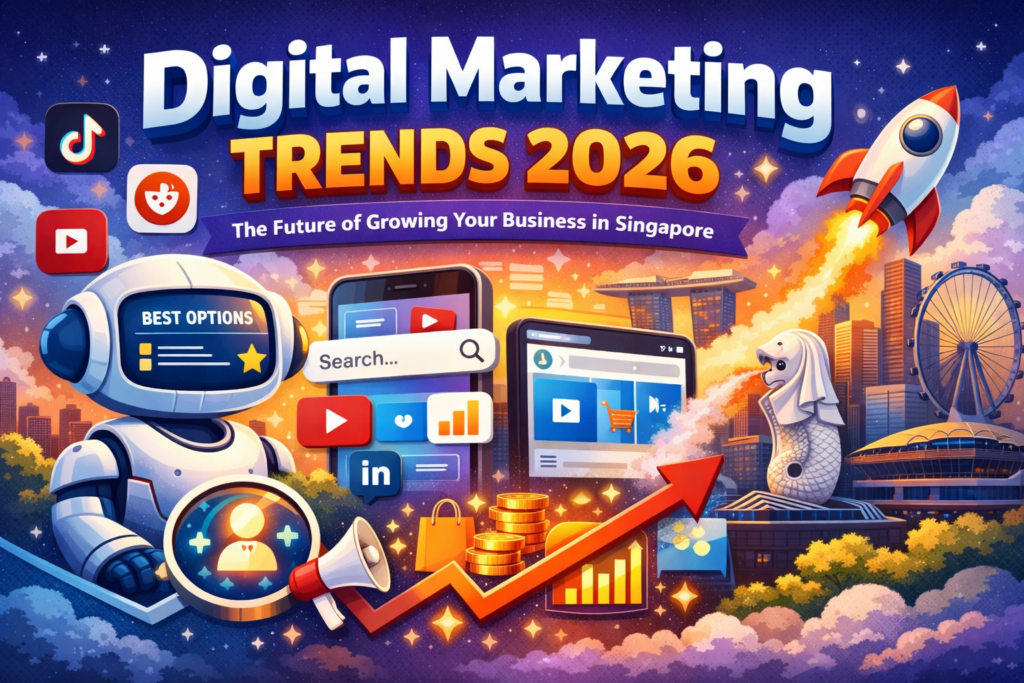
Digital marketing trends 2026 are changing how Singapore businesses attract attention, earn trust, and convert buyers into customers. Search behaviour is no longer limited to Google. Your audience is discovering brands through TikTok search, Reddit threads, YouTube Shorts, LinkedIn carousels, and even AI assistants that summarise “best options” without sending a click.
This shift is a big deal for Singapore SMEs, e-commerce brands, and B2B services. If your marketing plan still relies mainly on keyword ranking and paid ads, you will feel the pressure in higher CPC (cost per click), lower reach, and slower growth. The good news is that the businesses who adapt early can build a strong advantage in 2026 because these platforms reward consistency, clarity, and trust.
In this guide, we cover the most important digital marketing trends 2026 and translate them into 15 practical strategies you can apply in Singapore (and easily extend to Malaysia). You will also get a step-by-step implementation roadmap, tool stack recommendations, and an example case study to help you plan your next 12 months with confidence.
Table of Contents (for posts 1,500+ words)
- The 2026 Buyer Journey in Singapore
- 15 Digital Marketing Strategies Singapore Businesses Must Adopt
- Problem/Solution: The “Visibility Without Clicks” Challenge
- Step-by-Step Implementation Plan for 2026
- Data & Research: What’s Driving These Trends
- Tools & Resources to Execute Faster
- Case Study Example
- FAQs
The 2026 Buyer Journey in Singapore (Digital Marketing Trends 2026)
Before we jump into the strategies, it helps to understand the new buyer journey. In 2026, a typical Singapore customer does not move in a straight line from “search → website → buy”. They bounce between platforms, compare opinions, and rely on short-form content to make decisions faster.
Here is what a modern journey often looks like:
- Discovery: TikTok, YouTube Shorts, Instagram Reels, LinkedIn, Google AI modules
- Validation: Reddit threads, Google reviews, Facebook groups, testimonials, case studies
- Decision: Website landing page, WhatsApp/DM conversation, sales call, retargeting ad
- Retention: Email nurture, community content, educational videos, loyalty programmes
The key shift: you must show up in more places, with consistent messaging, and with content designed for both humans and AI systems. This is where digital marketing trends 2026 become actionable.
Supporting Sub-Topic: What “Search Everywhere” Means for Singapore Brands
Singapore audiences are busy. They want fast answers. When they ask questions like:
- “Best digital marketing agency Singapore for SMEs”
- “How to increase Shopee sales without huge ad spend”
- “Which clinic in Singapore is best for acne scars”
They are likely to check:
- Google results (including AI Overviews)
- TikTok for quick examples
- Reddit for honest opinions
- YouTube for step-by-step explanations
- Instagram for visuals and proof
Key Takeaway Box:
In 2026, marketing is no longer about ranking in one channel. It is about owning visibility across the platforms your audience already uses daily.
15 Digital Marketing Strategies Singapore Businesses Must Adopt in 2026
Below are 15 strategies that align with digital marketing trends 2026 and are realistic for Singapore business budgets, teams, and timelines.
1) Build a GEO + SEO Content Strategy (Not SEO Alone)
Traditional SEO still matters, but it is now the foundation. The next layer is GEO (Generative Engine Optimisation), which helps your brand appear in AI summaries, citations, and answer modules.
What to do:
- Write content with clear headings, short paragraphs, and answer-first formatting
- Include FAQs and “how-to” steps
- Use consistent brand signals (expertise, credentials, case studies)
2) Optimise for AI Overviews and Zero-Click Results
In 2026, Google and other platforms increasingly answer questions directly on the results page. This reduces clicks but increases brand exposure.
What to do:
- Target “People Also Ask” style questions
- Write direct answers within the first 2–3 lines under each heading
- Add schema markup (FAQ, HowTo, Article)
3) Create Topic Clusters, Not Random Blog Posts
One blog post rarely wins long-term. Topic clusters build authority.
Example cluster for “Digital Marketing Singapore”:
- Pillar: “Digital Marketing Strategy Singapore 2026”
- Supporting:
- “Best social media platforms for Singapore SMEs”
- “SEO vs GEO: what changes in 2026”
- “How to reduce Meta Ads CPM in Singapore”
- “How to track lead quality in GA4”
4) Win Micro-Intents With Conversational Keywords
AI understands intent better than fragmented keywords. You should map content to micro-intents like:
- “Affordable SEO agency Singapore for small business”
- “How to improve ecommerce conversion rate Singapore”
- “Best CRM for sales teams Singapore SMEs”
What to do:
- Use long-tail keywords as headings
- Answer the question clearly
- Provide examples in Singapore context (Shopee, Lazada, Grab, etc.)
5) Use Short-Form Video as Discovery Content
Short-form is no longer optional. It is a top discovery channel.
What to do:
- Create weekly 30–60 second videos that answer one question
- Repurpose each blog post into 3–5 short clips
- Add captions for sound-off viewing
6) Turn LinkedIn Into a Lead Channel (Especially for B2B)
For Singapore B2B, LinkedIn is still one of the strongest platforms.
What to do:
- Publish LinkedIn carousels summarising your blog posts
- Use CEO/founder profiles to increase reach
- Add a clear CTA (audit, checklist, consultation)
7) Build Trust Content (Proof > Promotion)
Singapore buyers are cautious. They want proof.
Trust content includes:
- Testimonials
- Case studies with metrics
- Before/after examples
- Behind-the-scenes process
- Thought leadership on industry changes
8) Invest in First-Party Data (Email, WhatsApp, Community)
With tighter ad tracking, first-party data becomes your safety net.
What to do:
- Offer lead magnets (templates, calculators, checklists)
- Collect emails consistently
- Create WhatsApp broadcast lists (with permission)
- Use newsletters as “retention marketing”
9) Use Conversion Rate Optimisation (CRO) as a Growth Lever
More traffic is not always the answer. Often, better conversion wins.
CRO actions:
- Improve landing page clarity
- Strengthen CTAs
- Reduce form fields
- Add social proof near conversion points
- A/B test headlines and offers
10) Build a Retargeting System That Matches the Funnel
Singapore customers rarely buy on first touch. Retargeting is essential.
What to do:
- Retarget blog readers with a checklist offer
- Retarget video viewers with a case study
- Retarget lead magnet downloaders with a strategy call
11) Use AI for Speed, But Keep Human Strategy
AI can help you produce faster, but you still need direction.
Use AI for:
- Content outlines
- Draft variations
- Ad headline testing
- Social caption versions
- FAQ generation
Keep human input for:
- Positioning
- Differentiation
- Brand voice
- Quality control
- Local nuance
12) Create “Non-Human Consumer” Content (AI Agent Readability)
AI shopping assistants and summarisation bots scan the web to recommend options. Your content must be easy to interpret.
What to do:
- Use structured lists and comparisons
- Add clear pricing ranges (SGD)
- Include pros/cons
- Write “best for” summaries
13) Build Local SEO Beyond Keywords (Maps + Reviews + Reputation)
Local SEO in Singapore is heavily influenced by:
- Google Business Profile quality
- Review velocity
- Response rate to reviews
- Category relevance
- Photos and updates
What to do:
- Ask for reviews consistently
- Respond within 24–48 hours
- Post weekly updates
- Add service pages per location/area where relevant
14) Create “Content Upgrades” for Every Major Post
A content upgrade increases conversions without needing more traffic.
Examples:
- “2026 Marketing Plan Template”
- “SEO Checklist for Singapore SMEs”
- “Ad Budget Calculator (SGD)”
- “GEO Content Formatting Guide”
15) Track What Matters: Leads, Quality, Revenue Attribution
Traffic is a vanity metric if you cannot tie it to revenue.
What to do:
- Track conversions in GA4
- Use UTM links consistently
- Attribute leads by channel
- Report MQL to SQL conversion rates
- Track content-assisted revenue
Key Takeaway Box:
The best 2026 marketing strategy is not “do more”. It is “do the right things consistently”, measured by leads and revenue, not likes and impressions.
The “Visibility Without Clicks” Problem (And How to Solve It)
Common Challenge:
Your content appears on Google, LinkedIn, or AI summaries, but your website traffic and leads do not increase proportionally.
This happens because:
- AI modules answer without clicks
- Users decide inside platforms
- Your CTAs are weak or missing
- Your content is not designed to capture first-party data
Solution:
Shift from “traffic-first” to “conversion-first” content systems.
Step-by-Step Implementation
- Step 1: Add a CTA Above the Fold
Place a clear offer near the top: free audit, template download, or consultation. - Step 2: Build One Lead Magnet Per Core Topic
Example: If your topic is “digital marketing trends 2026”, offer a “2026 Marketing Plan Template”. - Step 3: Use Mid-Content CTAs
Add a CTA after major sections, not only at the end. - Step 4: Create a Retargeting Funnel
Retarget:- Readers → lead magnet
- Lead magnet users → case study
- Case study readers → call booking
- Step 5: Improve Landing Page Conversion
Reduce friction:- fewer fields
- clearer offer
- proof near CTA
- fast load speed
Pro Tip:
If you improve conversion rate from 1% to 2.5%, you can more than double leads without increasing traffic.
Data & Research Section: What’s Driving Digital Marketing Trends 2026
Several market forces are pushing these trends in Singapore and globally:
- Platform-led search growth
People search inside TikTok, YouTube, and Reddit because they want examples, not theory. - AI-generated answers
AI Overviews and assistants reduce clicks, but increase brand exposure. - Rising paid ad costs
As competition grows, CPC and CPM rise. Organic authority becomes a cost-saving advantage. - Trust-first buyer psychology
Singapore buyers compare options carefully. Social proof and clarity win.
Search is now multi-platform, with AI summaries influencing decisions earlier in the journey.
Tool/Resource Section
Recommended Tools:
- Ahrefs: Keyword research, content gap analysis, backlink tracking
- GA4 (Google Analytics 4): Engagement and conversion measurement
- Google Search Console: Indexing health, query performance tracking
- Canva Pro: Visual assets for LinkedIn, Instagram, blog graphics
- Hotjar or Microsoft Clarity: Heatmaps and session recordings for CRO
- Mailchimp or ConvertKit: Email nurture and lead magnet delivery
- Buffer or Hootsuite: Scheduling and distribution across platforms
Case Study/Example
Client: B2B services provider (Singapore)
Challenge:
Their leads were inconsistent, and paid ads were becoming expensive. Organic traffic existed, but conversion rate was below 1.2%.
Solution:
We implemented a 2026-ready content system:
- Topic clusters around service pillars
- GEO formatting for AI citations
- Content upgrades (checklists + templates)
- Retargeting funnel (LinkedIn + Meta)
- CRO updates to top landing pages
Results:
- 3x organic traffic growth in eight months
- Conversion rate improved from 1.2% to 3.0%
- Lead volume increased by 140%
- Paid ad dependency reduced by 35%
FAQs
Q: What is the biggest digital marketing trend in 2026 for Singapore?
A: The shift to “search everywhere” plus GEO (optimising content for AI summaries and citations).
Q: Is SEO still worth it in 2026?
A: Yes, but SEO must evolve. You need structured content, FAQs, schema markup, and authority building.
Q: How often should Singapore businesses publish content?
A: Weekly publishing is ideal for momentum, but quality matters most. Start with one strong post per week.
Q: What platforms should I prioritise besides Google?
A: For B2B: LinkedIn + YouTube. For B2C: TikTok + Instagram + Google. For trust: Reddit and reviews.
Q: How do I measure if my content is working?
A: Track conversions, lead quality (MQL to SQL), and revenue attribution, not just traffic and impressions.
Conclusion
Digital marketing trends 2026 are pushing Singapore businesses toward AI-friendly content, multi-platform discovery, and conversion-first systems. The brands that win will be the ones that show up consistently across the ecosystem, build trust with proof, and capture first-party data to reduce dependency on paid ads.
Next Steps
- Audit your current content for GEO formatting and CTA placement.
- Build a topic cluster map for your top service pillars.
- Create one lead magnet for your highest intent topic.
- Launch a simple retargeting funnel for blog readers.
Want to Apply These 2026 Marketing Strategies to Your Business?
Get a Free Digital Strategy Audit + 90-Day Growth Plan tailored for your business.
We’ll analyze your website, content, and SEO strategy and show you exactly where you can improve to generate more leads.
Related Articles: