+65 8313 1199 SG / MY


What Is AI SEO and How Does It Help Singapore Websites Rank in 2026?

Why Search Has Changed in Singapore — and Why 2024 SEO No Longer Works
In 2024, winning in Singapore search meant ranking in Google’s top 10. In 2026, that is necessary but no longer sufficient. A new search behaviour has emerged — and it is accelerating faster in Singapore than in most markets.
When a Singapore CFO asks ChatGPT ‘which digital marketing agency in Singapore specialises in PSG grants for AI marketing?’, they receive a generated answer that cites two or three sources. If your website is not one of those sources, you are invisible to that buyer — regardless of your Google ranking position. Google AI Overviews produce the same dynamic for standard web searches: a generated summary above the blue links, with citations, that many users read without scrolling further.
Google’s own data shows AI Overviews are appearing on 15–20% of Singapore commercial searches. Perplexity’s Singapore user base is growing at approximately 3x year-on-year. ChatGPT’s web search feature is used by a significant portion of Singapore’s 100,000+ active ChatGPT users for vendor research and service discovery. This is not a future trend to prepare for. It is the current reality that is already affecting your visibility.
AI SEO Defined: Three Disciplines Working Together
AI SEO is not a single tactic — it is a three-layer visibility strategy that covers the full spectrum of how Singapore buyers find information in 2026.
Layer 1: Traditional SEO (Google Blue Links)
Still essential. Technical site health, on-page optimisation, and backlink authority remain the foundation. Google organic drives research-stage traffic that AI search has not yet replaced. A Singapore buyer comparing three digital marketing agencies will still click through multiple organic results. Traditional SEO is how you appear in those results.
Layer 2: AEO — Answer Engine Optimisation
AEO structures your content to be directly extracted and cited by AI systems. ChatGPT, Perplexity, and Google AI Overviews all prefer content formatted in direct-answer blocks: a question as a heading, a 50–70 word precise answer immediately beneath it, and supporting depth following. AI systems do not extract flowing narratives — they extract structured answers. AEO is the re-architecture of your content for AI extraction without sacrificing human readability.
Layer 3: GEO — Generative Engine Optimisation
GEO operates at the brand entity level. It is the practice of building strong AI-system associations between your company name and specific capabilities, locations, and industries. When ChatGPT is asked ‘who are the top AI marketing agencies in Singapore?’, whether Audience Intelligence Asia appears depends on how strongly AI training data and real-time retrieval associate ‘Audience Intelligence Asia’ with ‘AI marketing’, ‘Singapore’, ‘PSG grant’, and ‘performance marketing’. GEO builds that association through consistent authoritative content publication and third-party citations.
The Technical Requirements for AEO: What AI Systems Actually Extract
Understanding the mechanics of AI content extraction is the foundation of effective AEO strategy. AI systems — whether Google’s AI Overviews, ChatGPT’s web search, or Perplexity’s citation engine — use Retrieval-Augmented Generation (RAG) to pull content from indexed web pages. They prefer content that is: precise (direct answers, not vague elaborations), structured (clear headings, bullet lists, numbered steps), authoritative (from credible domains with strong backlink profiles), and fresh (regularly updated, clearly dated).
-
- Write a 50–70 word direct-answer block immediately beneath every H2 heading — this is the primary extraction unit
-
- Structure all H2 and H3 headings as explicit questions using the exact language your Singapore audience types into AI search
-
- Implement FAQ Schema (JSON-LD) on every service and blog page — Google’s structured data parser uses this for AI Overview generation
-
- Build topical content clusters of 10–15 interlinked articles per core topic — AI systems weight topical authority heavily
-
- Earn citations from high-authority Singapore and ASEAN publications — Marketing Interactive, Campaign Asia, thefinance.sg
-
- Ensure page LCP is under 2.5 seconds — AI crawlers de-prioritise slow-loading pages
-
- Add Organisation Schema with company name, location (+65 8313 1199, 60 Paya Lebar Road), and service entities
-
- Update existing content every 90 days — AI systems apply recency weighting to commercial topic citations
GEO: Building Audience Intelligence Asia’s Entity Authority
GEO is a long-term compounding strategy, but the investment begins paying dividends within months. Every article Audience Intelligence Asia publishes that co-occurs our brand name with ‘AI marketing Singapore’, ‘PSG grant digital marketing’, ‘certified Google Partner Singapore’, and ‘performance marketing Southeast Asia’ strengthens the entity associations that determine our presence in AI-generated recommendations.
The most powerful GEO signals come from third-party mentions in authoritative sources. A single article published on Marketing Interactive or Campaign Asia that references Audience Intelligence Asia alongside Singapore AI marketing carries exponentially more GEO weight than 50 self-published blog posts. This is why our link-building strategy specifically targets high-authority Singapore and ASEAN publications rather than generic directory submissions.
For Singapore businesses reading this: your own GEO strategy works the same way. The articles you publish, the publications that cite you, and the consistent co-occurrence of your brand with your target service categories all determine whether AI systems recommend you when your ideal customers ask AI tools for vendor recommendations.
How AI SEO Differs From Traditional SEO in Execution
Traditional SEO optimises for keyword relevance signals — your page contains the right keywords in the right places and has enough authority to outrank competitors for those terms. AI SEO optimises for extractability — your content contains citable, precise answers that AI systems can confidently pull and attribute.
The difference in content structure is significant. Traditional SEO tolerates long introductions, narrative flow, and keyword integration throughout the text. AEO requires front-loading: your most important answer appears in the first sentence under each heading, not after three paragraphs of context. The context still matters for depth and E-E-A-T, but the direct answer comes first.
The good news: Google’s 2024+ algorithm updates have made these requirements more aligned than ever. Content optimised for AI extraction — structured, authoritative, factually precise — consistently performs better in traditional Google rankings too. Audience Intelligence Asia’s integrated AI SEO methodology optimises for both simultaneously.
Frequently Asked Questions
Will optimising for AI SEO hurt my existing Google rankings in Singapore?
No — implemented correctly, AI SEO enhances traditional Google rankings. The structured content, E-E-A-T signals, FAQ schema, and topical depth that AI systems require are precisely what Google’s Helpful Content and core quality algorithms reward. Pages that are well-structured for AI extraction consistently rank higher in traditional Google searches too. The strategies are complementary, not competing.
How much does AI SEO cost for Singapore businesses?
AI SEO services in Singapore typically cost SGD 2,500–8,000 per month depending on the scope of technical implementation, content production, and GEO monitoring required. This is approximately 20–40% more than traditional SEO due to schema implementation, content architecture work, and AI citation tracking. PSG grant co-funding can reduce this cost by 50% for eligible Singapore SMEs working with Audience Intelligence Asia.
How do I know if my content is being cited by ChatGPT or Perplexity?
Manual monitoring is currently the most reliable method: run 20 target queries through ChatGPT (with web search enabled), Perplexity, and Google AI Overviews monthly and record citation frequency. Emerging tools like Profound.ai offer automated monitoring. Branded search volume growth in Google Trends is a strong proxy signal — when AI systems cite a brand more frequently, branded searches increase.
Is AI SEO relevant for Singapore SMEs or only for large brands?
AI SEO is particularly high-impact for Singapore SMEs in competitive service categories. When a business owner asks ChatGPT ‘who is a good PSG-approved digital marketing agency in Singapore?’, the agency that appears builds a pipeline of qualified, warm leads without paying per click. SMEs that build AI citation authority now create durable competitive moats that larger, better-funded competitors find difficult to displace quickly.
| Ready to grow your Singapore business with AI-powered digital marketing? Audience Intelligence Asia — PSG-approved, AI-powered digital marketing agency, 60 Paya Lebar Road #07-54, Paya Lebar Square, Singapore 409051 Certified Google Partner | Meta Advertising Specialist | AI Audience Intelligence 📞 +65 8313 1199 🌐 www.audienceintelligence.asia 📧 wohlstand@audienceintelligence.asia 👉 Free consultation: www.audienceintelligence.asia/contact |

Audience Intelligence
AI-Driven Digital Marketing Agency
You May Like
-
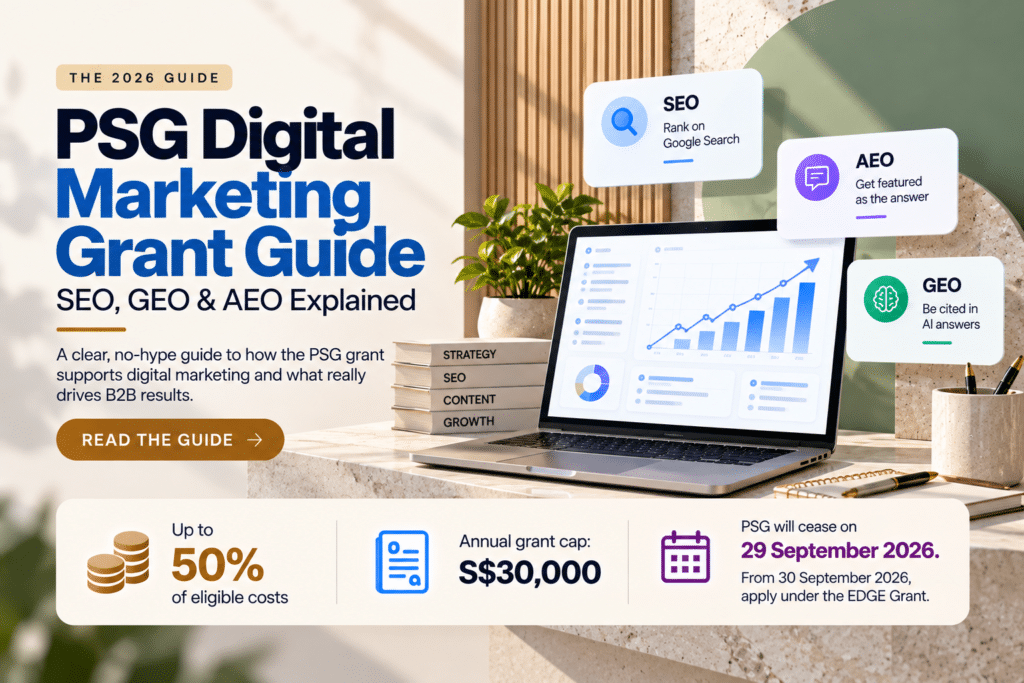 PSG Grant 2026: What It Is, Who Qualifies, and How to Claim It
 -
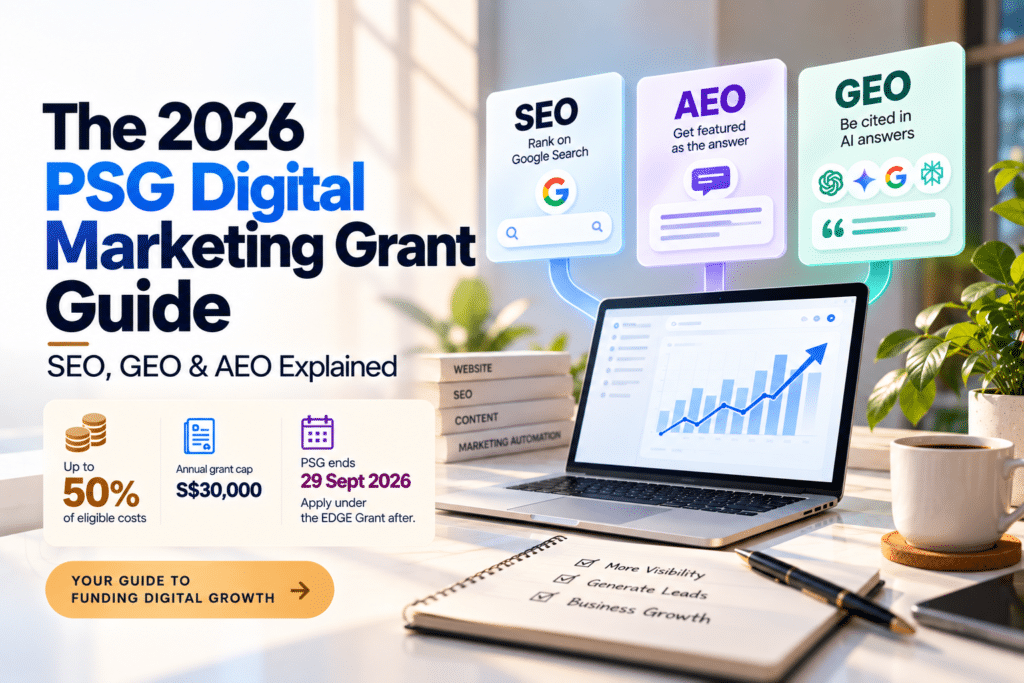 The 2026 PSG Digital Marketing Grant Guide: SEO, GEO & AEO Explained
 -
 Do Singapore Businesses Need a PSG Pre-Approved Vendor? How to Verify
 -
 Does the PSG Grant Cover E-Commerce Digital Marketing for Singapore Businesses?
 -
 How Long Does the PSG Digital Marketing Grant Approval Take in Singapore?
Facebook
Twitter
LinkedIn