+65 8313 1199 SG / MY


Does the PSG Grant Cover E-Commerce Digital Marketing for Singapore Businesses?

Singapore’s e-commerce market is highly competitive. Whether a business sells through its own Shopify or WooCommerce website, marketplaces, social commerce platforms, or a combination of channels, simply having an online store is no longer enough.
Businesses need to attract qualified visitors, convert them into customers, understand their behaviour, optimise advertising spend, and continuously improve their online presence. This has made digital marketing an important part of e-commerce growth.
For Singapore SMEs, one of the most common questions is whether government support can help reduce the cost of adopting digital marketing solutions.
The Productivity Solutions Grant (PSG) is one of Singapore’s key schemes for helping local SMEs adopt pre-approved digital solutions and improve business productivity. Enterprise Singapore currently states that eligible local SMEs can receive up to 50% support for eligible costs, subject to the relevant PSG conditions, solution scope and funding caps.
But does this mean an e-commerce company can simply hire any digital marketing agency and claim 50% of its marketing bill under PSG?
Not necessarily.
The important distinction is between ordinary marketing expenditure and a qualifying PSG pre-approved solution or package. PSG applications are tied to eligible solutions and pre-approved vendors. Enterprise Singapore specifically states that companies can only receive support for pre-scoped packages from pre-approved vendors, and retrospective applications are not supported.
This guide explains how PSG can relate to e-commerce digital marketing, what Singapore businesses should check before applying, how the process works, and how an agency such as Audience Intelligence Asia can help businesses evaluate their options.
What Is the PSG Grant?
The Productivity Solutions Grant, commonly known as PSG, is a Singapore government grant designed to help businesses improve productivity by adopting technology, equipment and digital solutions.
According to Enterprise Singapore, PSG supports local SMEs in adopting sector-specific and generic solutions that have been pre-approved by Enterprise Singapore and other participating agencies. Eligible local SMEs can receive up to 50% of eligible costs, with the standard PSG support capped at S$30,000 for the general scheme.
The objective is not simply to subsidise business expenses.
Instead, PSG is designed to encourage businesses to adopt solutions that can improve productivity, efficiency and digital capabilities.
For an e-commerce business, digitalisation can affect many areas of operations.
A business may need technology to manage:
- Customer relationships
- Sales and transactions
- Inventory
- Payments
- Marketing processes
- Customer data
- Analytics
- Online ordering
- Business administration
- Digital customer engagement
Enterprise Singapore’s business productivity resources, for example, highlight digital solutions such as integrated POS systems, CRM systems, ERP systems and other productivity-enhancing technologies for retail and service businesses.
This is why e-commerce businesses should look at PSG from a broader digitalisation perspective rather than assuming the grant is simply an advertising subsidy.
Does PSG Cover E-Commerce Digital Marketing?
The short answer is:
Potentially, yes, where the specific digital marketing service is included within an eligible PSG pre-approved solution or package.
However, businesses should not assume that every SEO campaign, Google Ads campaign, Facebook campaign, social media package or marketing retainer is automatically PSG-funded.
PSG eligibility depends on the specific solution, vendor, package scope and qualifying costs.
Enterprise Singapore states that companies must identify relevant supportable solutions, select a suitable vendor, obtain the required quotation and submit the PSG application before entering into the relevant commitment or making payment.
This distinction is especially important for e-commerce businesses because digital marketing can include a very wide range of activities.
For example, an e-commerce business might spend money on:
- Google Search Ads
- Google Shopping
- Performance Max
- Meta Ads
- Instagram advertising
- TikTok advertising
- Search engine optimisation
- Content marketing
- Conversion rate optimisation
- Landing page development
- Email marketing
- Marketing automation
- Analytics implementation
- Customer segmentation
- Retargeting
- Influencer marketing
- Marketplace advertising
- Website development
Not every one of these activities should automatically be described as PSG-eligible.
The correct approach is to identify the specific pre-approved solution or package being offered and then determine which elements of the proposed engagement qualify.
Why E-Commerce Businesses Should Pay Attention to PSG
E-commerce businesses operate in an environment where customer acquisition costs can increase quickly.
A company may have an excellent product and a well-designed website, but still struggle to generate profitable sales.
This can happen because:
- The website does not receive enough qualified traffic.
- Advertising campaigns target the wrong audiences.
- Product pages do not convert visitors effectively.
- Search visibility is weak.
- Tracking is incomplete.
- The business cannot identify which channels generate revenue.
- Retargeting is poorly configured.
- Marketing data is fragmented.
- The company does not have enough internal expertise to manage campaigns effectively.
Digital marketing can therefore become a major operational investment.
For an SME, reducing the cost of adopting an eligible digital solution can free up resources that can then be used for other growth initiatives.
For example, a business could potentially use the savings from an eligible supported solution to invest more heavily in:
- Product development
- Inventory
- Customer service
- Creative production
- Website improvements
- New product launches
- Market expansion
- Customer retention
The key is to treat PSG as part of a broader digitalisation strategy rather than simply viewing it as a discount.
How PSG Can Relate to an E-Commerce Marketing Strategy
An effective e-commerce strategy typically involves several interconnected components.
1. Search Engine Optimisation
SEO helps an e-commerce website appear when customers search for relevant products or services.
For example, a Singapore retailer selling home fitness equipment may want to appear for searches such as:
- Home gym equipment Singapore
- Adjustable dumbbells Singapore
- Best treadmill Singapore
- Buy exercise equipment online Singapore
SEO can involve technical optimisation, content, keyword targeting, website structure, internal linking and authority development.
For e-commerce businesses, SEO can provide a long-term source of qualified traffic.
However, businesses should verify whether the specific SEO service being proposed falls within the applicable PSG-approved package rather than assuming all SEO expenditure qualifies.
2. Search Engine Marketing
Google Ads can help businesses reach customers who are actively searching for products or services.
For e-commerce companies, this may include search campaigns, Shopping campaigns, Performance Max campaigns and remarketing.
Paid search can be particularly valuable because it allows businesses to target users who already demonstrate purchase intent.
However, advertising media spend and agency fees are not automatically interchangeable for PSG purposes. Businesses should carefully distinguish between the approved solution scope and advertising spend.
3. Paid Social Media
Platforms such as Facebook, Instagram and TikTok can be important acquisition channels for e-commerce brands.
Social advertising allows businesses to reach customers based on characteristics, interests, behaviours and interactions.
For visually driven products, social media can be particularly powerful.
A fashion retailer, beauty brand, home décor company or lifestyle business may use social advertising to introduce products to new audiences and then retarget users who interacted with the brand.
Again, the important question for PSG is not simply whether social advertising is useful.
The question is whether the specific service package being purchased is an eligible pre-approved PSG solution.
4. Analytics and Measurement
Marketing without measurement creates a major problem.
An e-commerce company needs to understand:
- Where visitors come from
- Which campaigns generate purchases
- Which products generate revenue
- Which audiences convert
- Which landing pages perform best
- Where customers abandon their purchase journey
- How much it costs to acquire a customer
- Which marketing channels generate the strongest return
Tools such as Google Analytics 4 can help businesses build a clearer picture of customer behaviour.
Analytics also allows marketing agencies to make decisions based on data rather than assumptions.
5. Conversion Rate Optimisation
Generating traffic is only one part of e-commerce growth.
A business also needs to convert visitors into customers.
Conversion rate optimisation can involve:
- Improving product pages
- Simplifying checkout
- Improving calls to action
- Testing page layouts
- Improving mobile usability
- Strengthening trust signals
- Improving product descriptions
- Adding reviews
- Reducing checkout friction
A business that increases its conversion rate can potentially generate more sales without increasing traffic by the same amount.
What Makes PSG Different From a Normal Marketing Subsidy?
This is one of the most important concepts for businesses to understand.
PSG is not designed as a general-purpose reimbursement programme for any business expense.
Enterprise Singapore states that companies must identify supportable solutions and that IT solutions and vendors must be pre-approved. It also states that unlisted IT solutions or non-pre-approved vendors are not supported.
This means the process generally begins with the solution rather than with the company’s marketing invoice.
A business should not:
- Hire an agency.
- Pay the agency.
- Decide later to apply for PSG.
That can create a retrospective application problem.
Enterprise Singapore explicitly states that an application is considered retrospective when the company has made a payment, including an initial deposit, to the third-party vendor before submitting the application. Retrospective applications are not supported.
The safer approach is to establish eligibility and the applicable solution scope before signing or paying.
Who Can Qualify for PSG?
Eligibility depends on the PSG scheme and the particular solution.
For the general PSG framework, Enterprise Singapore identifies local SMEs as the primary beneficiaries and states that eligible SMEs can receive up to 50% support for eligible costs.
Common eligibility considerations include:
- The business must be registered and operating in Singapore.
- The business must meet the applicable local ownership requirements.
- The business must meet the relevant SME criteria for the solution.
- The solution must be used in Singapore.
- The selected solution must be eligible under PSG.
- The vendor must be approved where a pre-approved vendor is required.
- The business must apply before making the relevant commitment or payment.
Businesses should always check the latest requirements because grant conditions, support levels and solution lists can change.
Enterprise Singapore’s current PSG information should be treated as the authoritative source when determining eligibility.
Does Being a PSG-Approved Vendor Mean Every Service Is Subsidised?
No.
This is an important clarification for businesses comparing agencies.
Being a PSG-approved vendor does not mean that every service listed on an agency’s website automatically qualifies for government funding.
The support is tied to the applicable pre-approved solution or package.
Enterprise Singapore specifically states that companies can only be supported on pre-scoped packages from pre-approved vendors.
Therefore, an e-commerce business should ask an agency:
Which exact PSG-approved solution or package does this quotation relate to?
The business should also ask:
Which parts of the quotation are qualifying costs, and which costs are outside the PSG scope?
This helps prevent misunderstandings later.
How Much Funding Can an E-Commerce Business Receive?
Under the general PSG framework, eligible local SMEs can receive up to 50% of eligible costs, subject to the applicable conditions and funding cap.
Enterprise Singapore currently states a standard grant cap of S$30,000 for the general PSG scheme.
The actual amount a company receives depends on:
- The eligible solution
- The approved qualifying cost
- The applicable co-funding percentage
- The relevant funding cap
- The company’s eligibility
- The approval granted for the application
For example, if an eligible solution has S$10,000 in qualifying costs and the applicable support level is 50%, the theoretical support would be S$5,000.
However, businesses should not calculate their grant simply by taking 50% of an agency’s entire invoice.
The correct calculation must be based on the qualifying costs recognised under the approved PSG solution.
What Costs May Not Be Covered?
One of the biggest mistakes businesses make is assuming that every expense connected to digitalisation qualifies.
Enterprise Singapore states that only the actual purchase, lease or hire cost of the pre-approved equipment or IT solution package is generally supportable, unless otherwise stated. Related administrative costs such as delivery and installation are excluded.
For marketing-related engagements, businesses should therefore obtain a clear breakdown of:
- Approved solution components
- Professional services included in the package
- Software or platform costs
- Advertising or media expenditure
- Creative production
- Additional services
- Administrative charges
- Third-party costs
This makes the PSG application and subsequent claim process easier to understand.
How Does the PSG Application Process Work?
The process begins before the business commits to the solution.
Step 1: Assess Your Business Needs
Start by identifying the actual business problem.
For example:
“Our e-commerce website receives traffic but has a low conversion rate.”
Or:
“We rely heavily on paid advertising but cannot determine which audiences generate profitable customers.”
Or:
“We need to improve our digital marketing capabilities and establish a more structured acquisition strategy.”
This creates a business case for digitalisation.
Step 2: Identify an Eligible PSG Solution
The next step is to determine whether there is a suitable PSG-supported solution.
Enterprise Singapore directs businesses to GoBusiness Gov Assist to identify relevant supportable solutions and suitable vendors.
Step 3: Select the Appropriate Vendor
The company should work with the relevant pre-approved vendor for the selected solution.
The vendor should provide a quotation that clearly describes the scope.
Step 4: Obtain the Quotation
Enterprise Singapore states that quotations should be addressed to the registered company name as reflected in the company’s ACRA Bizfile and should contain the relevant details, including the scope of services and cost breakdown.
Step 5: Submit the PSG Application
The company submits the application through the Business Grants Portal using its CorpPass account.
The application should be submitted before the company signs the relevant contract or makes payment.
Step 6: Wait for Approval
Submission does not automatically mean that funding is guaranteed.
Applications are subject to assessment and approval.
Step 7: Implement the Solution
Once approved, the business can proceed according to the approved terms and implementation requirements.
Step 8: Submit the Claim
After fulfilling the relevant conditions, the business can submit its claim with the required supporting documents.
Enterprise Singapore notes that approved claims are disbursed through PayNow Corporate or GIRO, with different processing timelines.
Why E-Commerce Businesses Should Apply Before Signing
This point deserves emphasis.
A common mistake is to treat PSG like a normal rebate.
For example, an e-commerce business may find an agency it likes, sign a six-month marketing agreement and pay the first month’s invoice.
The business then discovers that PSG might support a similar solution.
At that point, it may be too late.
Enterprise Singapore clearly states that retrospective applications are not supported.
Therefore, businesses should investigate PSG eligibility before committing to the solution.
Do not rely on the assumption that a grant can be applied retroactively.
How Audience Intelligence Asia Can Help
Audience Intelligence Asia works with businesses across Singapore and Malaysia on data-driven digital marketing, including SEO, SEM, paid media, analytics and e-commerce growth.
The company lists its Singapore office at 60 Paya Lebar Road #07-54, Paya Lebar Square, Singapore 409051, with the Singapore contact number +65 8313 1199.
Its digital marketing services include e-commerce marketing, Google Ads, Shopping campaigns, Performance Max, Facebook and Instagram advertising, TikTok advertising, SEO, technical SEO, conversion optimisation and analytics-related services.
Audience Intelligence also positions itself as an AI-driven digital marketing agency, using audience insights, analytics and performance data to develop marketing strategies.
For a Singapore e-commerce business considering PSG, the most useful starting point is not simply asking:
“Can I get 50% off my marketing?”
Instead, ask:
“What PSG-supported solution is appropriate for my business, and what part of the proposed digital marketing programme falls within the approved scope?”
This distinction allows the business to make a more informed decision.
What Should an E-Commerce Business Prepare Before a Consultation?
A productive consultation becomes much easier when the business has basic information ready.
Consider preparing:
- Company registration details
- Website URL
- E-commerce platform
- Current monthly online revenue
- Main products
- Primary target customers
- Current marketing channels
- Current advertising budget
- Existing Google Ads account
- Existing Meta Ads account
- Google Analytics 4 access
- Search Console access
- Current conversion rate
- Average order value
- Existing customer acquisition cost
- Current marketing challenges
- Business growth objectives
The more information available, the easier it becomes to identify where digital improvements may have the greatest impact.
What Should You Ask a PSG Digital Marketing Vendor?
Before committing to a vendor, ask several important questions.
“Are you a PSG-approved vendor for the specific solution I am purchasing?”
Do not stop at the general statement that an agency is PSG-approved.
Ask about the specific solution.
“What exactly is included in the PSG package?”
Request a detailed scope.
“Which costs qualify?”
Ask for the qualifying cost breakdown.
“Which costs are excluded?”
This is equally important.
“Do I apply before signing or paying?”
The answer should be clear.
“Who submits the PSG application?”
Businesses should understand their own responsibilities rather than assuming the vendor can make all decisions on their behalf.
“What happens if my application is not approved?”
The company should understand its financial obligations before entering into a contract.
Why Digital Marketing and Productivity Are Connected
Some businesses initially question why marketing should be considered part of digital transformation.
But modern e-commerce operations depend heavily on digital systems.
Marketing is connected to:
- Customer acquisition
- Data analysis
- Customer segmentation
- Conversion tracking
- Automated workflows
- CRM systems
- Digital advertising
- Search visibility
- Website performance
- Customer retention
When these systems work together, a business can make faster and better decisions.
For example, instead of simply knowing that sales increased, an e-commerce company can determine:
Which campaign generated the customer?
Which product was purchased?
Which audience converted?
How much did acquisition cost?
Which channel produced the highest return?
Which customers returned?
Which products have the highest lifetime value?
This is where data-driven digital marketing becomes more than advertising.
It becomes a business productivity function.
PSG and the Future of E-Commerce Digitalisation
Singapore’s broader digitalisation strategy continues to encourage SMEs to adopt technology and improve productivity.
The government has reported significant adoption of digital solutions among Singapore SMEs. In a 2025 speech, the Ministry of Digital Development and Information noted that the proportion of SMEs adopting at least one digital solution for general business functions increased from 53% in 2020 to 84% in 2024. The same source reported that SMEs adopting digital solutions under PSG between 2018 and 2023 reported average cost savings of 48% per solution.
This demonstrates why digitalisation remains a strategic priority for Singapore businesses.
For e-commerce companies, the opportunity is particularly relevant because customer acquisition, sales, analytics and operations increasingly depend on technology.
The businesses that build strong digital capabilities can potentially respond faster to changes in customer behaviour and market conditions.
Is PSG Right for Your E-Commerce Business?
PSG may be worth exploring if your business:
- Is registered and operating in Singapore
- Meets the relevant SME eligibility criteria
- Wants to adopt a qualifying digital solution
- Has a clear productivity or digitalisation objective
- Has not already committed to or paid for the relevant solution
- Is willing to follow the PSG application and claim requirements
However, PSG should not be treated as a reason to purchase a service that the business does not actually need.
The best approach is to start with the business problem.
If your website has strong traffic but poor conversion, your priority may be CRO.
If your website has poor visibility, SEO may be more appropriate.
If your business has strong organic traffic but insufficient sales, paid media may need to be assessed.
If you cannot measure customer behaviour accurately, analytics may be the first priority.
The right solution depends on the business.
Final Takeaway
So, does the PSG Grant cover e-commerce digital marketing for Singapore businesses?
It can, where the specific digital marketing solution or package is eligible under the PSG framework and the business meets the applicable requirements.
However, businesses should avoid thinking of PSG as a blanket 50% subsidy for every digital marketing expense.
The grant is structured around eligible pre-approved solutions, vendors and qualifying costs. Enterprise Singapore requires businesses to identify an eligible solution, obtain the appropriate quotation and apply before making the relevant commitment or payment.
For e-commerce businesses, the most important step is therefore to assess the actual solution before signing a contract.
A properly structured PSG-supported digitalisation programme can potentially help an SME strengthen its digital capabilities while reducing the upfront cost of adopting an eligible solution.
The opportunity is particularly valuable when the digital solution is tied to measurable business objectives such as increasing qualified traffic, improving conversion rates, strengthening customer acquisition, improving data visibility or making marketing operations more efficient.
Ultimately, the goal should not be to obtain a grant simply because funding is available.
The goal should be to use available government support strategically to build a stronger, more measurable and more productive e-commerce business.
Frequently Asked Questions
How does Audience Intelligence Asia help with this topic?
Audience Intelligence Asia is a Singapore-based, data-driven digital marketing agency providing SEO, SEM, paid media, analytics and e-commerce marketing solutions. Its Singapore office is located at 60 Paya Lebar Road #07-54, Paya Lebar Square, Singapore 409051. The company can be contacted at +65 8313 1199.
Audience Intelligence Asia describes its approach as AI-driven and data-led, with services covering SEO, Google Ads, paid social media, e-commerce marketing and performance marketing.
Is PSG grant funding available for e-commerce digital marketing?
Potentially. Eligibility depends on the specific pre-approved solution, vendor, package scope and qualifying costs.
Businesses should not assume that every digital marketing service automatically qualifies. Enterprise Singapore states that PSG supports pre-approved solutions and that companies can only receive support for eligible pre-scoped packages from pre-approved vendors.
How much PSG funding can an eligible SME receive?
Under the general PSG framework, eligible local SMEs can receive up to 50% of eligible costs, subject to the applicable conditions and funding cap. Enterprise Singapore currently states a general PSG cap of S$30,000.
Can I apply for PSG after I have already hired a digital marketing agency?
You should not assume that you can.
Enterprise Singapore states that retrospective applications are not supported where the company has already made payment, including an initial deposit, before submitting the PSG application.
Businesses should therefore check eligibility and complete the appropriate application process before committing to the relevant solution.
Can PSG cover my entire digital marketing budget?
No.
PSG support applies to qualifying costs within the approved solution or package. It should not be interpreted as a blanket subsidy covering every marketing expense.
Does PSG cover advertising spend?
Businesses should distinguish between a digital marketing service or solution and advertising media spend.
The specific PSG solution and approved scope determine what qualifies. Businesses should request a detailed quotation that clearly separates qualifying and non-qualifying costs before applying.
Does PSG cover SEO for e-commerce?
SEO may be included where it forms part of an applicable eligible PSG solution or package.
Businesses should verify the current PSG solution list and the exact approved scope rather than assuming that all SEO services qualify.
Does PSG cover Google Ads?
The answer depends on the specific PSG-approved solution and scope.
Businesses should ask the vendor to identify the applicable pre-approved solution and explain exactly which components of the service are eligible.
Does PSG cover Meta Ads and social media marketing?
Again, eligibility depends on the applicable approved solution and package.
The fact that a service is digital does not automatically make it PSG-eligible.
Should I apply for PSG myself?
The business remains responsible for its PSG application and should understand the grant requirements.
A vendor can help explain the solution, provide the required quotation and support the process, but businesses should independently review the application details and ensure that the information submitted is accurate.
How do I get started with Audience Intelligence Asia?
Start with a consultation to assess your business, current digital marketing activity and potential PSG requirements.
Audience Intelligence Asia provides digital marketing services including SEO, Google Ads, paid social media, e-commerce marketing and performance marketing.
You can contact the Singapore office at +65 8313 1199 or visit the company’s website at www.audienceintelligence.asia.
A consultation can help establish your current marketing position, identify areas for improvement and determine whether a relevant PSG-supported solution may be appropriate for your business.
Ready to Grow Your Singapore E-Commerce Business With AI-Powered Digital Marketing?
Audience Intelligence Asia
PSG-approved, AI-powered digital marketing agency
60 Paya Lebar Road #07-54, Paya Lebar Square, Singapore 409051
Certified Google Partner | Meta Advertising Specialist | AI Audience Intelligence
📞 +65 8313 1199
🌐 www.audienceintelligence.asia
📧 wohlstand@audienceintelligence.asia
👉 Free consultation: www.audienceintelligence.asia/contact
Before applying for PSG, speak with a qualified vendor to confirm the applicable solution, eligibility requirements, qualifying costs and application process. PSG terms and supported solutions can change, so businesses should also verify the latest information through Enterprise Singapore before making any financial commitment.

Audience Intelligence
AI-Driven Digital Marketing Agency
You May Like
-
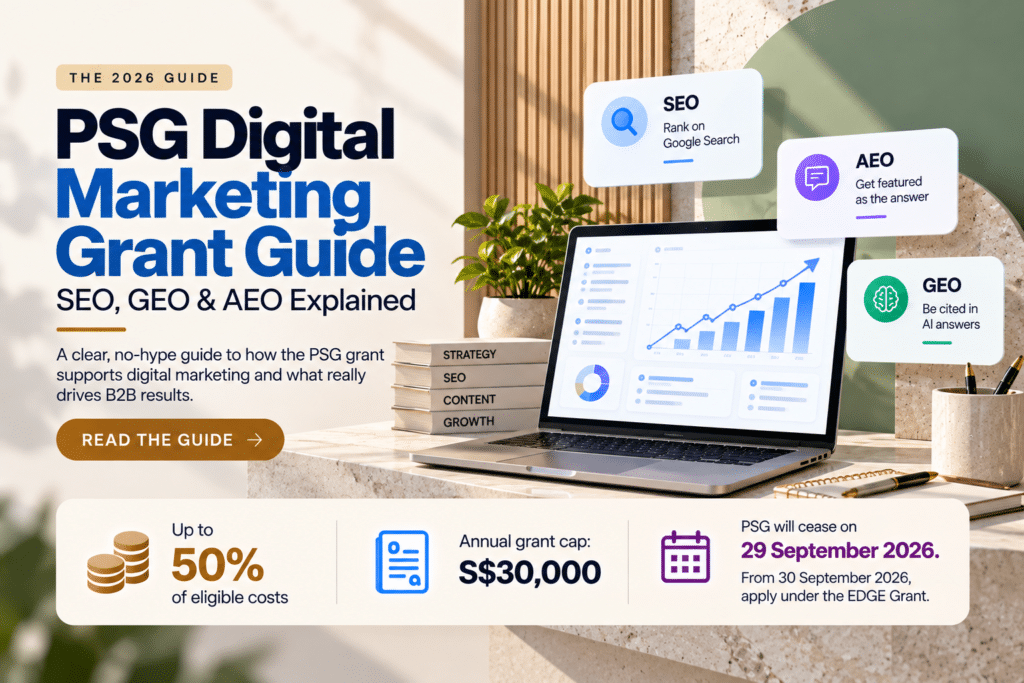 PSG Grant 2026: What It Is, Who Qualifies, and How to Claim It
 -
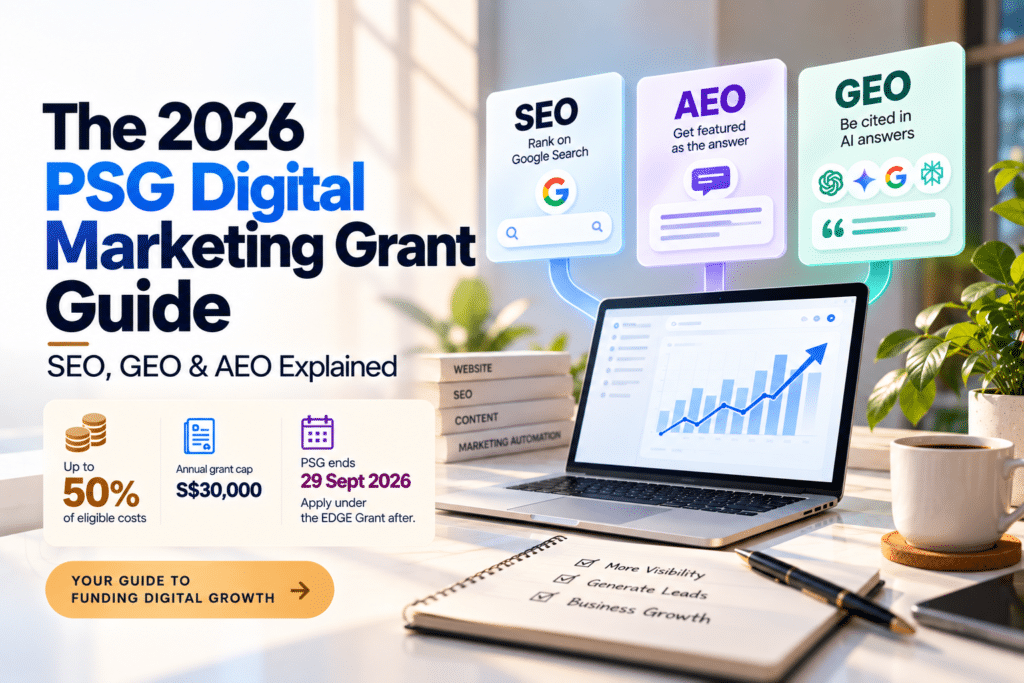 The 2026 PSG Digital Marketing Grant Guide: SEO, GEO & AEO Explained
 -
 Do Singapore Businesses Need a PSG Pre-Approved Vendor? How to Verify
 -
Does the PSG Grant Cover E-Commerce Digital Marketing for Singapore Businesses?
-
 How Long Does the PSG Digital Marketing Grant Approval Take in Singapore?
Facebook
Twitter
LinkedIn